Technical Resources & Documentation
Access comprehensive technical specifications, test reports, and guidance documents for architects, engineers, contractors, and waste management professionals.
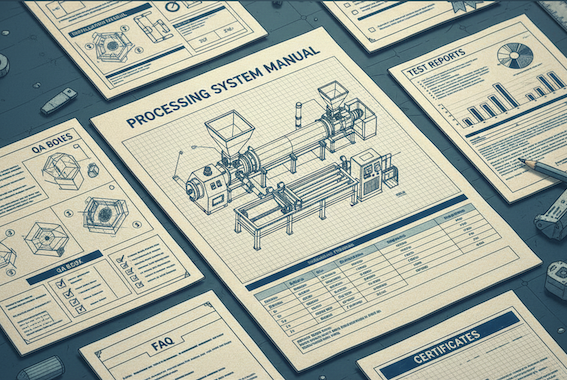
Deployment Models
Samsara's Green Upcycling Process (GUP) utilizes a modular platform to achieve a capital-efficient deployment model. This modularity facilitates collaboration between public and private partners, enabling them to launch with low upfront CAPEX and scale operations as demand grows. Furthermore, the modular configuration offers the flexibility to install specific end-market application modules, supporting "just-in-time" deployment. The inherent distributed processing ability enables partners to more efficiently manage their respective feedstock.
Stand-Alone Configuration
All three modules, Pre-compounding, compounding and forming, is all housed in the same plant. Plastic waste is collected and sorted at different Material Recovery Facilities (MRF) to sort recyclable plastic for recyclers. Non-recyclable material is compacted, baled and sent to the processing all inclusive processing plant. This configuration is ideal for an entrepreneur who wants to control the entire process flow.
2-Step Distributed Processing (2SDP)
Post sorting, non-recyclable material is shredded and pre-processed into pellets at the MRF. Resulting pellets are free from decomposition odor and bacteria. They take up less storage room, allowing MRFs to accumulate plastic waste prior to delivery to the compounding center. Each compounding center can serve several MRFs, ensuring a steady flow of plastic waste for a continuous compounding process that transforms the plastic waste pellets into the Sustainable Plastic Waste Composite (SPWC). The compounding center will further form SPWC into EcoBriks and other end-market applications to address local specific needs.
3-Step Distributed Processing (3SDP)
Same as 2SDP, except that the end-market forming module is not located at the compounding center but closer to the market. This is the ideal configuration for rural areas where feedstock is collected and baled by farmers or residents. The feedstock is brought to a Transfer Station/MRF where it is shredded, pelletized with other residential plastic waste, then sent to a compounding center. The compounding center ships SPWC to different end-market application formers in different cities. Total CAPEX and OPEX can therefore be spread among several stakeholders, enabling quicker adoption.
Desired Site Conditions
- Existing waste management facility on-site
- Access to 2,000+ tonnes/year plastic waste
- Light-Industrial zoning
- Truck access and loading infrastructure
- 800+ kW electrical service available
- Local demand for construction materials
Video Resources
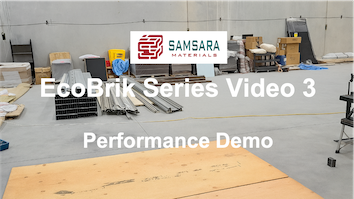
EcoBrik Job-site Tasks
This demo shows how EcoBrik performs under real working conditions.
Watch on YouTube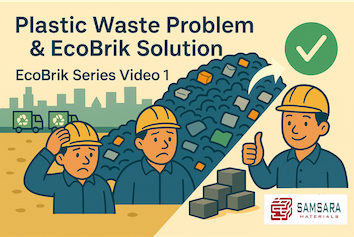
Plastic Waste & EcoBrik Solution
This demo shows how Samsara Materials addresses the plastic waste challenges.
Watch on YouTube
Technical Downloads
Comprehensive documentation regarding specifications, design details, and regulatory approval processes is available upon request.
Product Data Sheet
Complete specifications including dimensions, weights, physical properties, and performance characteristics.
Application Guide
Detailed guidance on suitable applications, installation methods, and design considerations for various projects.
Compliance Test Summary
Summary of strength and durability tests by certified independent laboratories, including ASTM, CSA and EPA standards.
EcoBrik Paver Installation Guide
A step-by-step manual for the installation and foundational preparation of EcoBrik plastic-composite pavers.
EcoBrik Modular Plant Fact Sheet
Overview of the modular plant configurations, footprint requirements, production capacity, and deployment options for prospective partners.
EcoBrik Carbon Impact
Quantified analysis of CO₂ avoidance, plastic diversion rates, and embodied carbon savings per unit of EcoBrik produced.
Frequently Asked Questions
What is EcoBrik made from?
Mixed plastic waste (flexible films and rigid packaging) and mineral aggregates. No cement or water required in production.
How strong is EcoBrik compared to concrete bricks?
Compressive strength (reaching over 48 MPa) exceeds that of high-density concrete bricks used in paving and cladding.
Does EcoBrik absorb water or crack in freeze–thaw conditions?
Low absorption (0.2–0.4%) and strong resistance to freeze-thaw cycles; suitable for wet climates and harsh weather conditions.
Is EcoBrik safe for the environment?
Yes. Cement-free production, low energy consumption, and leachate release of only 0.0017%. Designed to safely encapsulate plastic waste.
How is EcoBrik installed?
Same methods and tools as concrete brickwork. Standard masonry saws, drills, and mortar applications are fully compatible.
Can EcoBrik be used in load-bearing walls?
Currently intended for paving, cladding, landscaping, and fencing. Structural use requires engineering approval and additional testing.
What types of plastic waste can Samsara accept?
Mixed unwashed films, multilayer packaging, agricultural plastics, marine-recovered waste, and other non-recyclable plastics. PVC and heavily contaminated materials are excluded.
Where is EcoBrik currently being tested or deployed?
Tested by certified independent labs in Canada and Taiwan. Piloted in selected demonstration paving sites.
How can I get technical support or project-specific advice?
Contact us through the form on our Contact page for designers, engineers, regulators, and waste management professionals.
Is EcoBrik more expensive than traditional bricks?
Pricing is competitive with premium concrete pavers. Total project installation cost is lower due to faster installation and less expensive tools and accessories requirements.
Can EcoBrik be recycled at end of life?
Yes. EcoBrik can be mechanically reprocessed into new units or used as aggregate in future production, maintaining circularity.
What end market products are planned?
Fascia boards, roofing panels, siding boards, structural posts, and fencing systems…by adapting a different forming module. If you have a different end market in mind, we can work with you to develop new modules for specific needs.
Investor Section
Confidential materials, financial reports, and due diligence documents are available to authorised investors through our secure Virtual Data Room.
Samsara team? Sign in with your @samsaramaterials.com email.
Need More Information?
Can't find what you're looking for? Our technical team is ready to answer your questions and provide custom documentation for your project.